Punjab has entered a new era of digital land management with the introduction of the Green Property Certificate (GPC), a landmark initiative launched by the Punjab Land Records Authority (PLRA). The new system is designed to replace the centuries-old Fard system and establish a more secure, transparent, and legally reliable framework for property ownership verification across Punjab.
The Green Property Certificate is one of the most significant reforms in Pakistan’s land administration sector. It combines ownership verification, possession confirmation, legal scrutiny, and digital authentication into a single government-issued document.
As Punjab continues its province-wide rollout throughout 2026, property owners, investors, overseas Pakistanis, banks, and real estate professionals need to understand how this new system works and how it will affect future property transactions.
What is a Green Property Certificate?
A Green Property Certificate (GPC) is an electronically generated property verification document issued through the Punjab Land Records Authority (PLRA).
Unlike the traditional Fard, which primarily records ownership details, the Green Property Certificate provides a more comprehensive verification of:
- Property ownership
- Physical possession
- Land boundaries
- Legal standing
- Transaction eligibility
- Property verification status
The objective is to create a more secure and transparent property ecosystem where buyers and sellers can confidently conduct transactions based on verified information.
Why Punjab Replaced the Traditional Fard System
For decades, the Fard served as the primary proof of land ownership in Punjab. However, the system faced several limitations:
Major Problems with Fard
- Forged ownership records
- Property scams
- Illegal transfers
- Incomplete ownership verification
- Lack of possession confirmation
- Limited legal due diligence
- Corruption in manual record handling
Government officials state that the Green Property Certificate was introduced to eliminate these weaknesses and create a modern digital property ecosystem.
Latest Government Updates on Green Property Certificate
According to Punjab Land Records Authority announcements:
- Sahiwal became the first pilot district from May 1, 2026.
- Fard issuance was suspended for transactional purposes in Sahiwal.
- Lodhran and Hafizabad are scheduled for the next implementation phase.
- Punjab plans a province-wide rollout by December 2026.
The Board of Revenue has also recognized Green Property Certificates and Property Reports as valid transaction documents under the updated regulatory framework.
Key Features of the Green Property Certificate
1. Digital Authentication
The certificate is generated through PLRA’s digital land record management system, reducing dependence on manual documentation.
2. Ownership Verification
The system verifies ownership records using computerized land databases maintained by the government.
3. Possession Confirmation
Unlike traditional records, the Green Property Certificate includes verification of actual possession through field inspections.
4. GPS-Based Survey
Modern surveying techniques help validate property boundaries and physical dimensions.
5. Public Objection Window
A public notice period allows stakeholders to raise objections before issuance.
6. Fraud Prevention
The system is designed to minimize risks associated with duplicate ownership claims, forged documents, and unauthorized transfers.
7. Enhanced Transparency
A structured verification process allows objections and disputes to be identified before certification is issued.
Green Property Certificate vs Fard
| Feature | Traditional Fard | Green Property Certificate |
|---|---|---|
| Ownership Verification | Yes | Yes |
| Possession Verification | No | Yes |
| GPS Survey | No | Yes |
| Public Notice Process | No | Yes |
| Digital Authentication | Limited | Yes |
| Fraud Prevention | Limited | Advanced |
| QR Verification | No | Yes |
| Legal Due Diligence | Limited | Enhanced |
Legal Status of Green Property Certificate
The Green Property Certificate operates under the regulatory framework established by:
- Punjab Land Records Authority Act 2017
- Punjab Land Revenue Act 1967
- Punjab Land Records Authority Regulations 2025
- Board of Revenue Punjab directives
In pilot districts, Green Property Certificates and associated Property Reports are becoming the primary documents for land transactions.
Who Needs a Green Property Certificate?
The certificate is particularly important for:
- Property buyers
- Property sellers
- Overseas Pakistanis
- Real estate investors
- Financial institutions
- Mortgage applicants
- Inheritance transfers
- Commercial property transactions
How to Apply for a Green Property Certificate
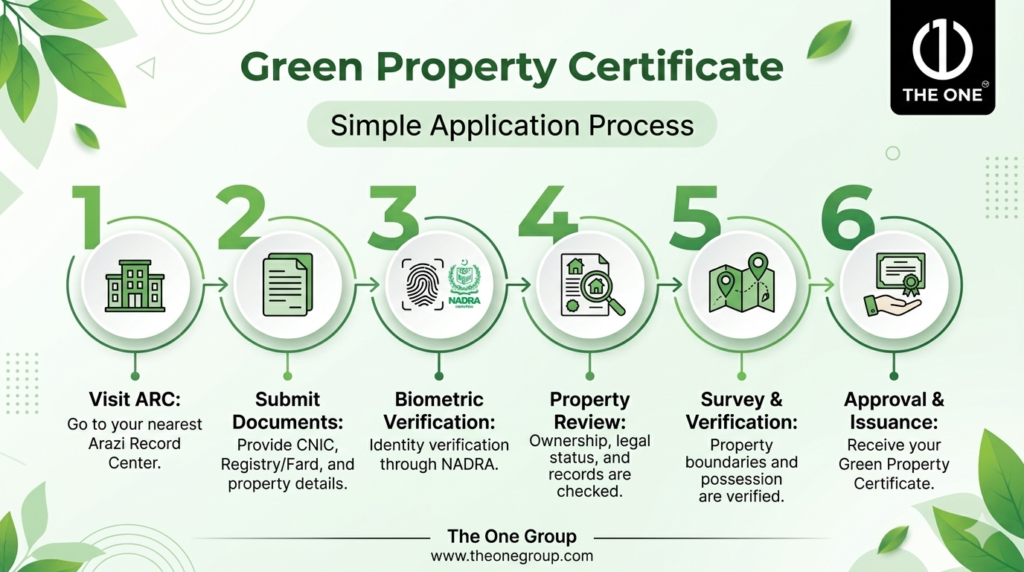
Step 1: Visit an Arazi Record Center (ARC)
Property owners initiate the process at their nearest PLRA Arazi Record Center.
Step 2: Submit Application
Applicants provide ownership information, property records, and identification documents.
Step 3: Identity Verification
Identity verification is conducted through NADRA-linked biometric systems.
Step 4: Record Scrutiny
Officials review:
- Ownership history
- Encumbrances
- Court cases
- Government restrictions
Step 5: Field Survey
Field teams conduct physical inspections and boundary verification.
Step 6: Neighbor Verification or Stakeholder Verification
Where applicable, neighboring landowners may verify possession and ownership status.
Step 7: Public Notice Period
Property information may be displayed for public review to identify objections.
Step 8: Final Approval
Authorized officers review all documentation before approving issuance.
Step 9: Certificate Issuance
The Green Property Certificate is generated and made available to the applicant.
Documents Required for Green Property Certificate
Applicants may be required to provide:
- Original CNIC
- Property ownership documents
- Existing Registry
- Existing Fard (where applicable)
- Property identification details
- Khasra information
- Supporting ownership records
Requirements may vary based on property type and district implementation status.
Property Reports Under the New System
PLRA has introduced multiple property reports:
Non-Transactional Report
Used for informational purposes.
Semi-Transactional Report
Used for legal and administrative verification.
Transactional Property Report
Required for property transfer transactions.
These reports work alongside the Green Property Certificate to establish complete property verification.
Benefits for Overseas Pakistanis
Overseas Pakistanis often face difficulties verifying property ownership remotely.
The Green Property Certificate system can help by:
- Improving access to verified records
- Reducing dependency on intermediaries
- Enhancing transparency
- Supporting remote property verification
Impact on Punjab Real Estate Market
Industry experts expect the Green Property Certificate to:
- Increase buyer confidence
- Reduce fraudulent transactions
- Improve property transparency
- Strengthen mortgage approvals
- Enhance investor trust
- Modernize land administration
Common Mistakes to Avoid
Before applying:
- Ensure ownership records are updated.
- Resolve pending mutations.
- Verify property boundaries.
- Clear outstanding legal disputes.
- Confirm CNIC information is current.
Final Thoughts
Punjab’s Green Property Certificate initiative has the potential to transform the province’s real estate landscape by replacing outdated verification methods with a more comprehensive and technology-driven approach.
For buyers, sellers, and investors, understanding this new system is essential for navigating future property transactions confidently and securely.
At The One Group, we believe informed decisions lead to successful investments. Our team continuously monitors regulatory developments, property laws, and market trends to help clients make confident real estate decisions across Pakistan.
Need guidance regarding property verification, investment opportunities, or real estate transactions? Contact The One Group today and let our experts assist you every step of the way.